The US Senate voted 62-33 to pass the Bipartisan American Affordability and Jobs Act of 2026 (BAAJA), which would overhaul federal permitting of energy projects, transmission lines and other infrastructure. The bill passed as an amendment replacing the text of H.R. 2347, a House-passed tax bill. Under Section 1402, sponsors of 46 project types, including solar, wind, storage, fossil fuel and nuclear, could sue over permits denied in bad faith or delayed over 60 days. The House must act before the bill reaches the president.
JinkoSolar has reported a power conversion efficiency of 35.24% for a perovskite tandem solar cell built on N-type TOPCon silicon, up from its previous 34.82% with the same configuration. The company said the Shanghai Institute of Microsystem and Information Technology of the Chinese Academy of Sciences certified the result, reached over five months. One outlet calls it a new cell efficiency record, while another notes Longi holds the perovskite-silicon tandem world record at 35.5%, set in July 2026.
Economic consultancy Compass Lexecon has prepared a report for European power industry association Eurelectric titled "Negative prices in EU power markets." It concludes that negative wholesale electricity prices do not necessarily indicate market failure and can steer investment toward energy storage, demand-side flexibility and electrification when they reflect real supply and demand. When they persist because of infrastructure constraints or poorly designed support mechanisms, they can create inefficiencies and extra costs. The frequency and duration of negative prices vary significantly across European markets.
Briggs & Stratton has introduced the SimpliPHI 16, a 16 kWh lithium iron phosphate battery aimed at simplifying installation, commissioning and maintenance of energy storage systems. It is rated for 8,000 cycles at 90% depth of discharge, a 0.5C charge and discharge rate, 70% end-of-life capacity and at least 96% round-trip efficiency. Up to 16 units can run in parallel per stack and 32 per system, reaching 512 kWh for residential and commercial use. It is the first storage battery developed jointly with the company's electrification division.
India’s Union Cabinet has approved INR 145 billion in viability gap funding for grid-scale energy storage projects during fiscal years 2026-27 to 2030-31. The scheme targets 92 GWh of capacity: 60 GWh from pumped storage hydropower, 30 GWh from battery storage and 2 GWh from other technologies. It is intended to add capacity equivalent to 170% of India’s current grid-scale storage and contribute toward a projected need of 411 GWh by 2031-32. The projects are expected to draw INR 976 billion in investment.
Honduras's state utility ENEE said Zamorano University is the first self-generating customer in the country to be paid for surplus renewable power fed into the grid. The university's 1,954.84 kWp solar plant in San Antonio de Oriente uses 4,832 modules, has an authorized AC output of 1,600 kW, and relies on a bidirectional meter. Exports are credited monthly on bills under CREE Resolution CREE-89-2026, published Oct. 1, at $111.27/MWh for medium-voltage and $92.50/MWh for low-voltage connections.
Lebanon's Cabinet of Ministers has approved a plan, presented by Energy and Water Minister Joe Sadeh, to add at least 3 GW to 3.5 GW of generation capacity over the coming years. Gas-fired plants will continue to supply baseload power using imported liquefied natural gas, while solar, wind and battery storage are designated as key sources of new capacity. Existing hydroelectric facilities will be rehabilitated, and the government is exploring cooperation with Qatar on renewables and storage. Citizens face high energy costs, heavy reliance on private generators, and outages on the Électricité du Liban grid.
Researchers in Iran have designed and tested a wind-driven system that cools and cleans photovoltaic modules without using electricity. A vertical-axis wind turbine, built from two second-hand bicycle rims and blades cut from 110 mm PVC pipe into 70 cm half-pipe sections, drives a mechanical water pump through a belt. The pump draws water from a reservoir and sprays it through a nozzle onto the module surface to lower its temperature and wash away dust. Without generators, batteries or inverters, all of the PV output is preserved.
Jordan’s Ministry of Energy and Mineral Resources unveiled plans for new large-scale solar and storage projects during the inaugural Jordan-EU Investment Conference, held last week. The ministry is planning to invite private investors to develop a 200 MW solar project and a 100…
Ten renewable energy startups presented their businesses at the fifth Startup Pitch Competition, hosted by Mercom Capital in partnership with RE+. A panel of three judges heard the pitches: Stephanie Annerose of HASI, Alexander Carbone of Clairvest, and Mercom Capital Group CEO Raj Prabhu. Prabhu said all ten finalists were addressing pressing market challenges. Among them was Cosmic Robotics, which is bringing a tracked, battery-electric robot called Cosmic-1 that loads its own pallet of solar modules to utility-scale solar construction.
Takenaka Corp. said its hydrogen-linked energy management system at a 24-unit apartment building in Kurobe, Toyama prefecture, shifted surplus summer solar power into winter as intended during its first year of operation. The setup pairs Takenaka's I.SEM energy management system with a power-to-gas unit that turns excess summer solar into green hydrogen, stores it in a hydrogen-absorbing alloy, and converts it back to electricity and heat via a fuel cell in winter. Waste heat supports the building's heat-pump hot-water supply. The seven-story building in YKK Real Estate's Passive Town was completed in March 2025, and the system began operating in April 2025.
The Saudi Electricity Regulatory Authority (SERA) has updated its rules for renewable self-consumption systems, raising the maximum capacity covered from 2 MW to 50 MW. The framework covers solar, wind, waste-to-energy and biofuel installations, requires generation and consumption at the same facility, and permits integrated battery storage. Grid-connected systems now fall into four categories: 1–11 kW, 11–50 kW, 50 kW–2 MW, and 2–50 MW. Residential-scale systems in the smallest category need no prior approval but must be notified and installed by an accredited contractor.
Daikin has introduced replacement technology for its R-32-based Mini VRV 5 S-series heat pumps that lets existing R-410A VRV and VRF systems be upgraded to R-32 equipment while keeping suitable refrigerant piping and wiring. Daikin says installation time can drop by up to 22% and capital expenditure by up to 55% versus full replacement, with energy savings of up to 16%. The RXYSA-B replacement range comes in 4, 5 and 6 HP sizes and uses R-32, whose GWP of 675 is about 68% lower than R-410A.
Under the One Big Beautiful Bill Act, US energy storage projects that begin construction after Dec. 31, 2025, must meet foreign entity of concern restrictions to claim federal clean energy tax credits, and a certificate of origin alone is not enough to secure financing. For standalone storage, the main credit is the Section 48E investment tax credit, with separate rules for the 45Y and 45X credits. IRS interim guidance in Notice 2026-15 sets out how compliance with prohibited foreign entity and material assistance cost ratio rules is measured. This matters because utility-scale systems rely heavily on lithium iron phosphate cells.
San Diego-based Unigrid, whose team grew out of research at the University of California, San Diego, is developing sodium-ion batteries for markets where lithium-ion is less suitable. CEO Darren Tan cited better safety, non-flammability, long cycle and calendar life, and wide thermal tolerance, while noting the cells are heavier and bulkier. The company's 48V Na+ Casa series for commercial and residential storage discharges from about -100°F to +140°F and charges down to about -68°F. The batteries are UN38.3 certified and tested to UL 9540A at the cell level.
The Global Energy Storage Alliance (GESA) was launched on Nov. 13 at the China Pavilion during COP31 in Antalya, Turkey, with 27 co-initiating organizations including battery makers, utilities, state-owned enterprises and research institutions. Its founders are the China Energy Storage Alliance, the China Renewable Energy Engineering Institute and China Southern Power Grid Energy Storage Co. Co-initiators include CATL, BYD Energy Storage, EVE Energy, Hithium, Sungrow and Saudi developer ACWA Power, while seven groups such as the Long Duration Energy Storage Council are exploring participation.
Women in Solar+ Europe (WiSEu) marked International Men's Day with a piece celebrating men in the solar, energy storage and wider energy transition industries who recognise talent beyond gender, challenge stereotypes and support others' growth. The network's founder argues that building a more inclusive industry is a shared responsibility and that gender equality benefits everyone rather than being a competition. The piece frames the sector's common goal of a sustainable, secure and resilient energy future as grounds for rethinking how people work together.
Spain's government approved a royal decree on Nov. 20 setting energy sustainability, environmental, resilience and digital sovereignty requirements for data centers, including a requirement for 80% renewable electricity. The Council of Ministers also approved the electricity transmission network development plan through 2030. Minister for Ecological Transition Sara Aagesen said data center projects hold grid access permits for 15 GW, nearly 40% of peak demand, with another 20 GW awaiting access, far above the under-4 GW projected for 2030 in the 2024 AI Strategy.
An analysis of US solar manufacturing finds about 40 companies actively producing silicon PV components domestically, from polysilicon to modules, each with a different growth model out to 2030. Capital expenditure from 2020 to 2026 has clustered in specific states, with Texas leading PV capex in 2026, helped by Canadian Solar's module expansion in Mesquite. The landscape remains fragmented, but a consolidated, production-led approach could emerge if the sector unites on a technology roadmap and a domestic materials-based supply chain.
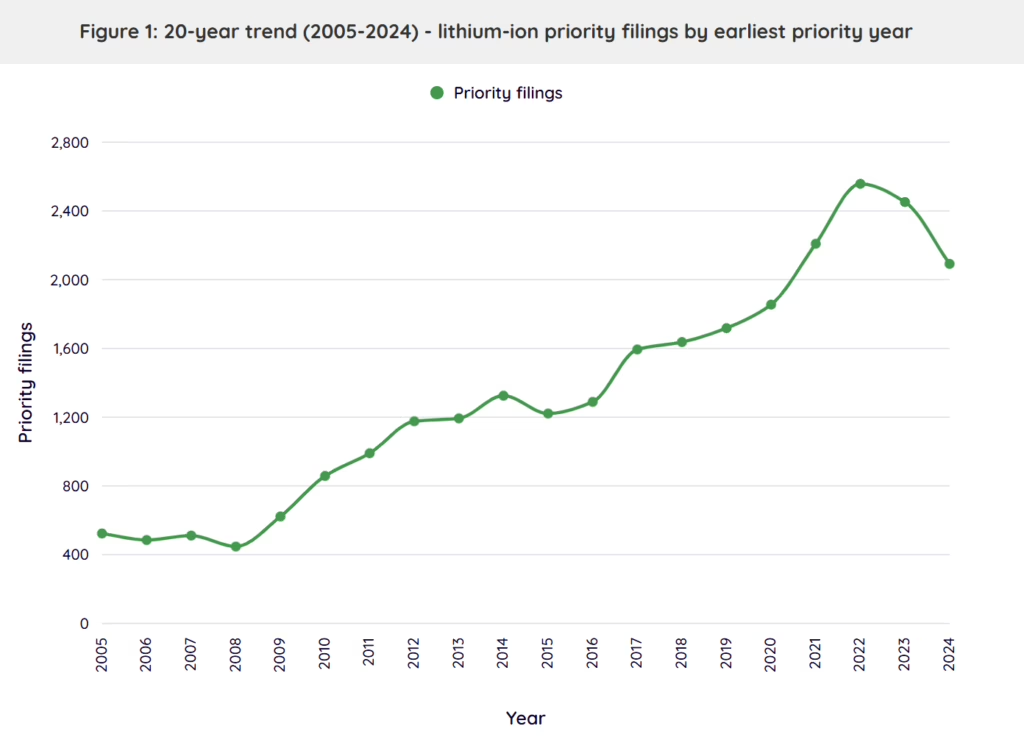
Global patent filings for solid-state batteries rose 16% to a record 2,230 in 2024, while lithium-ion battery filings fell nearly 15% to 2,092, according to intellectual property firm Appleyard Lees' sixth annual Inside Green Innovation report. South Korea overtook Japan as the leading filer with 873 applications versus 605, driven largely by Samsung SDI, which nearly doubled its filings from 165 to 325. China ranked third with 217 filings and Europe reached a record 177.
US tariffs on battery energy storage system (BESS) imports are among the steepest worldwide, with Section 301 forced-labor duties lifting effective tariffs on Chinese LFP battery cells to 40.9%, on top of Section 232 duties on steel, aluminum and copper that hit auxiliary components such as power control systems and enclosures. Combined tariffs add over $35/kWh to Chinese LFP BESS imports, with US prices forecast to rise to $195/kWh in 2027 versus about $140–160/kWh in Europe. Chinese consumption tax and export VAT changes are expected to add a further $4/kWh.